Authors, Guest Speakers, Musicians, Scholars, Workshops, Concerts
|
On August 24, 2019, from noon to 8 p.m., Appalachian Heritage Day will transpire at Southern West Virginia Community and Technical College's Logan Campus in Mt. Gay, WV. The event will celebrate Appalachian history, culture, economic development, and tourism. Regional authors, guest speakers, scholars, and musicians will be featured throughout the day. The event is free to the public. THANK YOU to the Logan County Commission, the Hatfield-McCoy CVB, and the Southern Coalition for the Arts for sponsoring this event!
Anyone who is interested in occupying a table in order to sell Appalachian-themed merchandise, offer information, or promote an agency should click below! |
Host Institution: Southern West Virginia Community and Technical College

Building A, Logan Campus. http://www.southernwv.edu/
Southern West Virginia Community College was established as an independently accredited, comprehensive community college on July 1, 1971, through the consolidation of two existing branches of Marshall University. These branches, located in Mingo and Logan Counties, had been in operation under Marshall’s direction since 1963 and provided the first two years of liberal arts and teacher education, as well as career programs in secretarial science and radiologic technology. In 1971 these two locations became the first two campuses of Southern when it became an independently accredited institution of higher education. It was also in 1971 that Southern’s first building was completed in Williamson.
Since 1971 the College has continued to expand its academic, workforce development, and community service offerings. In 1976 the West Virginia Board of Regents established formal service areas for each of the state's public colleges and universities. Southern was assigned an area of approximately 1,900 square miles that included the counties of Boone, Logan, Mingo, and Wyoming. In 1981 the College’s service area was expanded through an interstate agreement with Kentucky, which provided for students from Martin and Pike counties to attend Southern at the in-state tuition rate.
In 1995, with a renewed emphasis on workforce development and technical training, the state legislature changed the names of all community colleges in the state to emphasize their technical components, and Southern’s name became Southern West Virginia Community and Technical College. In addition to the name changes, Senate Bill 547 also outlined eleven community and technical college districts throughout the state, which added three additional West Virginia counties--Lincoln, McDowell and Raleigh--to Southern's district. McDowell and Raleigh were identified as "shared counties" with responsibility for providing educational opportunities shared with two other community colleges.
Along with increasing enrollment, expansion of the geographic area served, and growth in the number and types of programs offered, the College's physical facilities have also grown through the years. Beginning with the original building on the Williamson Campus in 1971, new facilities have been constructed throughout the College's district. The construction of the first Logan Campus building was completed in 1979, and a new addition was added in 1987. In Wyoming County a new location was selected near Twin Falls State Park, and a building was constructed there in 1989. This location has added new classrooms and remodeled the student commons area since that time. In 1996, the Boone Campus relocated from a renovated facility in Madison to a new building adjacent to the Boone County Career and Technical Center. The Earl Ray Tomblin Workforce Development Center and Administrative Complex (Building B) opened in Logan in October 1998, and in 1999 a new library wing was added to the Williamson Campus. In the fall of 2007, a first of its kind classroom physically connected to the Lincoln County Comprehensive High School was opened to better serve the Lincoln County area. The College welcomed students into a new 55,000 square foot, state-of-the-art Allied Health and Technology Center on the Logan Campus in January 2008. In April of 2013 Southern proudly opened its state-of-the-art Applied Technology Center on the Williamson Campus, which greatly enhances the opportunities for career training in Mingo County and surrounding communities. In 2016, the College acquired and continues to renovate the adjacent National Guard Armory building and property. These facilities allow Southern to continue to provide comprehensive education and training to meet the needs of current and future credit and non-credit students.
Through the years, Southern has developed educational agreements with several public and private colleges and universities to provide local access to additional opportunities for those who have completed the associate degree. This local access to baccalaureate and master's degree programs utilizes a variety of delivery modes, including on-campus, traditional instruction, as well as electronic distance learning and on-line instruction. These agreements with higher education institutions throughout the state and across the nation are continuously updated and new ones initiated as needed.
Higher education governance in West Virginia has undergone many changes over the years. Since 2001, Southern West Virginia Community and Technical College has been a member of the West Virginia Council for Community and Technical College Education. This system provides for each member institution to have a local Board of Governors, and the Council serves as a policy and coordinating board.
In 2006, in cooperation with the Southern West Virginia Community College Foundation, the College launched its first Major Gifts Campaign‚ Vision 2020‚ with the purpose of raising additional funds to assist in achieving a number of long-range goals related to academic programs, physical facilities, and improving student financial support. This campaign's success and support by the local communities has been extraordinary.
Although the institution continues to face many challenges, Southern continues to provide the highest quality programs and services and remains committed to meeting the educational and training needs of the residents of its service district.
Host Town: Logan (Mt. Gay), West Virginia

|
The host town for Appalachian Heritage Day 2019 is Logan, WV. Established in the 1820s as Lawsonville, later Lawnsville, the town became known as Aracoma in the 1850s. Originally a trading post in the mid-section of the Guyandotte Valley, the town became an important timber town. Popularly known as Logan Court House for much of the 1800s, the town officially became Logan after 1900. The arrival of the C&O Railroad in 1904 remade Logan as a coal center.
The town is rich in history. Native American history, symbolized by the story of Chief Cornstalk's daughter Aracoma, can be found here. Well-known antebellum poet Thomas Dunn English, a rival to Edgar Allan Poe, served as mayor in the 1850s. Devil Anse Hatfield once operated a hotel in town. Elias Hatfield, brother of Anse and father of governor Henry D. Hatfield, lived here. Controversial sheriff Don Chafin, best known for his role in the Mine Wars, was a Loganite. Heavyweight boxing champion Jack Dempsey was reared in Logan area. Numerous well-known musicians have lived in the vicinity: Frank Hutchison, Ed Haley, Ed Belcher, Arnold and Ervin Williamson, Dick Justice, Aunt Jennie Wilson, Roger Bryant, and Landau Eugene Murphy, Jr., to name a few. Today's Logan and adjoining communities are complimented by vibrant theatrical programs, Chief Logan State Park, the Coalfield Jamboree, Old City Cemetery, the Don Chafin House, Country Roads Byway Visitor Center, Historic Omar, Historic Holden, the Hatfield Cemetery, and the Blair Mountain battle site. Just beyond Logan is Chapmanville, home of the Kanawha Gap Civil War battle site, and Man, site of the Buffalo Creek Flood disaster. Outdoor recreation opportunities center on the Hatfield-McCoy ATV Trail System and kayaking on the Guyandotte River. Dedication: Aunt Jennie Wilson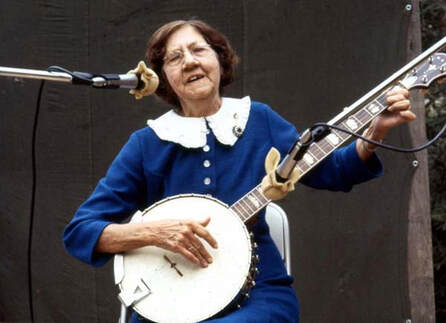
Aunt Jennie Wilson
Virginia Myrtle Ellis “Aunt Jennie” Wilson (February 9, 1900-March 2, 1992) was a Logan County traditional musician, considered a master of clawhammer-style banjo playing. The daughter of Huey Brian and Cinderella Lockard Ellis, she was born near Henlawson, West Virginia. She married James Wilson but was widowed in 1939 when he was killed in a mine accident.
Wilson’s musical talent was discovered by folklorist Patrick Gainer of West Virginia University in 1958, and she became a favorite of folk festival audiences until her death. She recorded her best songs for the Library of Congress and was featured on record albums, including A Portrait of Aunt Jennie Wilson, produced by Billy Edd Wheeler. She left behind recorded interviews about her early life and the folk customs of Logan County. Known for her vivid personality as well as her music, she was fond of saying, ‘‘Don’t take more on your head than you can kick off your heels,’’ meaning one should enjoy life to the utmost, which she did. She often played music with her grandson, Roger Bryant, and inspired other musicians to learn the clawhammer style. She was a recipient of the 1984 Vandalia Award, West Virginia’s highest folk-life honor, for lifetime achievement in traditional music. Written by Robert K. Spence for the West Virginia Encyclopedia Project https://www.wvencyclopedia.org/articles/1284 Schedule of EventsCampus opens at 7 AM
Participants set up 10 AM to 12 PM BLDG A, RM 120 GUEST SPEAKER PRESENTATION ROOM 12:00-12:30 Craig Ferrell: “The Art of Flintknapping and Stone Tool Replication” 12:30-1:00 Eric Simon: “Appalachian Lost and Found” 1:00-2:00 Jim McCoy: Reality TV Star: "Hatfields and McCoys: White Lightning" 2:00-2:30 Billie Johnson: “Virginia Ricketts” 2:30-3:00 Ernest Blevins: “Civil War Monuments” 3:00-4:00 James Baldwin: “The History of the Baldwin-Felts Agency and the Massacre at Matewan” 4:00-4:30 James Baldwin: “The Shooting of Sid Hatfield” 4:30-5:00 Courtney McCoy: Reality TV Star: "Hatfields and McCoys: White Lightning" BLDG A, RM 121 SCHOLAR PRESENTATION ROOM 12:00-1:00 Robert Thompson: “Rebel Bill Smith and Regional Civil War Officers” 1:00-2:00 Brandon Kirk: “The Lincoln County Feud” 2:00-3:00 Dr. Paul Rakes: “’Meanest County in the Nation’: Fayette’s Coal Mining Frontier” 3:00-4:00 Dr. Charles Keeney: “The Mine Wars Museum and Heritage Tourism in the Coalfields” 4:00-5:00 Dr. Chris Green: “Voice: Renaissance and Revolution” BLDG C, RM 202 AUTHOR PRESENTATION ROOM 12:00-1:00 Mack Samples: 23 Shots 1:00-2:00 Cat Pleska: “Fearless: Appalachia Women and Inspiration from the #MeToo Movement” 2:00-3:00 Carter Taylor Seaton: “Hippie Homesteaders” 3:00-4:00 Laura Treacy Bentley: “Come Walk with Me: An Irish-American Pilgrimage” 4:00-5:00 Carter Taylor Seaton: "The Rebel in the Red Jeep" BLDG A, OLD BOOKSTORE AUTHOR READING ROOM 12:00-12:30 Gwendolyn Mason: Readings from Selected Works 12:30-1:00 Billie Johnson: “An Introduction to Apple Grove: The Ultimate Town for Reenactors” 1:00-1:30 Sandy Litteral: Readings from Selected Works 1:30-2:00 M. Lynne Squires: Urban Appalachia 2:00-2:30 INTERMISSION: Almost Heaven Dulcimer Club 2:30-3:00 Cat Pleska: Riding on Comets 3:00-3:30 Juanita Mays: Readings from Selected Works 3:30-4:00 Brenda Boylan: Heritage, Art, Process 4:00-4:30 Laura Treacy Bentley: Readings 4:30-5:00 Sarah Andreas: Leadership and Women Who Ride Bikes 5:00-5:30 Cora Hairston: Readings and Reflections BLDG A, RM 122 GENEALOGY WORKSHOP 2:00-3:00 Logan County Genealogy Society: “Researching Your Appalachian Roots” 3:00-3:30 Hester Baisden Hodges: “John Smith Baisden and His Descendants” 3:30-5:00 Logan County Genealogy Society: “Researching Your Appalachian Roots” BLDG A, RM 123 WRITERS’ WORKSHOP 2:00-3:00 Lillie Teeters: “Connecting to Your Appalachian Heritage” 3:00-4:00 Lillie Teeters: “Connecting to Your Appalachian Heritage” 4:00-5:00 Lillie Teeters: “Connecting to Your Appalachian Heritage” BLDG A, RM 212 MOUNTAIN DULCIMER WORKSHOP 12:00-1:30 David O’Dell BLDG A, RM 212 OLD-TIME FIDDLE WORKSHOP 3:00-4:30 Bobby Taylor BLDG A, RM 218 BLUEGRASS FIDDLE WORKSHOP 1:30-3:00 Buddy Griffin BLDG A, RM 259 SONGWRITING WORKSHOP 1:30-3:00 Roger Bryant BLDG A, RM 259 OLD-TIME BANJO WORKSHOP 3:00-4:30 Kim Johnson and Cody Jordan BLDG A, RM 204 PAST PRESENTERS I (VIDEO) 12:00-1:00 Patchwork: A Conversation with Roger Bryant and Aunt Jennie Wilson (1979) 1 hour 1:00-1:30 Patchwork: The Hatfields and McCoys: A Conversation with Otis K. Rice (1979) 32 minutes 1:30-2:00 Thunder Along the Guyandot: Explosive Excavation for the R.D. Bailey Dam (n.d.) 28 minutes 2:00-3:00 Images of Appalachia: Fact, Fiction, Folklore: Denise Giardina (1991) 53 minutes 3:00-4:00 Images of Appalachia: History and Humor: Lon Savage (1992) 43 minutes 4:00-5:00 Medicinal Plants of Southern Appalachia: Dr. Rebecca S. Linger (2009) 43 minutes 5:00-5:40 A Lecture by Wyline Dial on the Language of Appalachia (1978) 40 minutes BLDG A, RM 205 PAST PRESENTERS II (VIDEO) 12:00-1:00 An Interview with Jimmy Wolford (2012) 53 minutes 1:00-2:00 Images of Appalachia: Fact, Fiction, Folklore: Otis Rice (1991) 54 minutes 2:00-3:00 Images of Appalachia: Ronald D. Eller (1995) 59 minutes 3:00-4:00 Images of Appalachia: Steam, Steel, and Stars: Timothy R. Hensley (1993) 65 minutes 4:00-5:30 Archeology in Southern West Virginia with Ron Moxley (1983) 79 minutes SAVAS-KOSTAS THEATER (BLDG A) 1:00-3:00 Bill Hairston, emcee Liam Farley Webb Twins String Band Paul Gartner Blessed-Adkins Family Nathaniel Chapman 3:00-5:00 Bill Hairston: Storytelling and emcee Mack Samples Elaine Purkey: Labor Songs Almost Heaven Dulcimer Club 6:00-8:00 Bill Hairston, emcee Roger Bryant Buddy Griffin Kim Johnson Cody Jordan David O’Dell Elaine Purkey Mack Samples and the Samples Brothers Band Bobby Taylor IN FRONT OF BUILDING A FOOD VENDORS BLDG A, MAIN HALLWAY AUTHOR TABLES Sarah Andreas James Baldwin Laura Treacy Bentley Brenda Boylan Cora Hairston Billie Johnson Brandon Kirk Sandy Litteral Gwendolyn Mason Juanita Mays Cat Pleska Mack Samples Carter Taylor Seaton M. Lynne Squires Robert Thompson BLDG A, MAIN HALLWAY INFORMATION AND VENDOR TABLES Goldenseal magazine (Joseph Aluise) West Virginia State Archives and History (WV State Historian Joe Geiger) Battle of Kanawha Gap artifacts (Vinny Mendez) West Virginia Mine Wars Museum (Kenzie and the traveling display) Sticks (Lillie Teeters) United Daughters of the Confederacy (Billie Johnson) Guyandotte Water Trail (Christy Bailey) National Coal Heritage Authority (Christy Bailey with pop-up exhibit) West Virginia Humanities Council (Eric Waggoner and Victoria Paul) Sons of Confederate Veterans, Camp A.G. Jenkins (Roger Casey) Appalachia Book Company (Natalie Axton) Jenny Wiley State Park (Emily Lawson) Sons of the American Revolution (Andrew Bragg) Almost Heaven Dulcimer Club (Helena Lee) Ramblin' Rose (Jessica Frye) https://www.facebook.com/RamblinRose1980/ Appalachian Center for the Arts (Executive Director Robin Irwin) Handcrafted Book Accessories (Brian Sperger) DirectionsTo reach the host site from Charleston, follow 119 South to Logan and exit onto Route 73, making a right onto Mud Fork Road.
To reach the host site from Huntington, follow Route 10 South to Chapmanville, then access 119 South to Logan and exit onto Route 73, making a right onto Mud Fork Road. To reach the host site from Williamson, follow 119 North to Logan and exit onto Route 73, making a right onto Mud Fork Road. To reach the host site from Pineville, follow Route 10 North to Logan, then proceed on Route 73, making a left onto Mud Fork Road. ParkingPersons who are part of the program should park behind Building A. General attendants should park in front of Building A, in front of or beside of Building C, or beside of Building B.
Lodging
Attendants who seek lodging for the event will find several options, particularly the Chief Logan State Park Lodge, Candlewood Suites Logan, Holiday Inn Express Logan, and Best Western Logan Inn. The surrounding area offers cabin rentals. Access to Logan is greatly enhanced by Corridor G (Route 119), a four-lane highway linking Charleston, WV, and Pikeville, KY.
|


